Jennifer Chambers | November 2026
Pancreatic Cancer Breakthrough: RAS Inhibitor Daraxonrasib
- A rare moment of excitement in pancreatic cancer: daraxonrasib has generated striking clinical results in a disease where progress has historically been slow.
- This breakthrough could have implications beyond one cancer type: by targeting RAS mutations, the therapy may open the door to wider advances across several major cancers.
- What insurers should be watching: improved survival, greater use of targeted cancer therapies and shifting claims assumptions could all reshape how advanced cancers are assessed.
It’s not every day – or even every year – a cancer drug receives a standing ovation at the most influential cancer conference in the world. Yet that’s exactly what happened when investigators revealed Phase III trial results for daraxonrasib (marketed as Rasonque) at a plenary session at ASCO 2026, a major cancer conference, in Chicago. The audience ‘cheered, whistled, and yelled for a full 42 seconds’. Why was this considered a significant breakthrough? [1]
A novel targeted therapy, daraxonrasib’s results showed encouraging advances in prospect for patients with advanced pancreatic cancer, historically one of the most lethal cancers with limited treatment options. The trial looked at patients who had progressed after first line chemotherapy. The findings suggest outcomes in this group clearly exceed those associated with historical second-line chemotherapy. Response rates among users of the new drug were meaningfully higher, at around 29%, and median overall survival doubled, improving to approximately 13 months, compared with around 6-7 months under conventional treatment. These results point to a tangible improvement in patient outcomes in a setting where progress has historically been limited. [2]
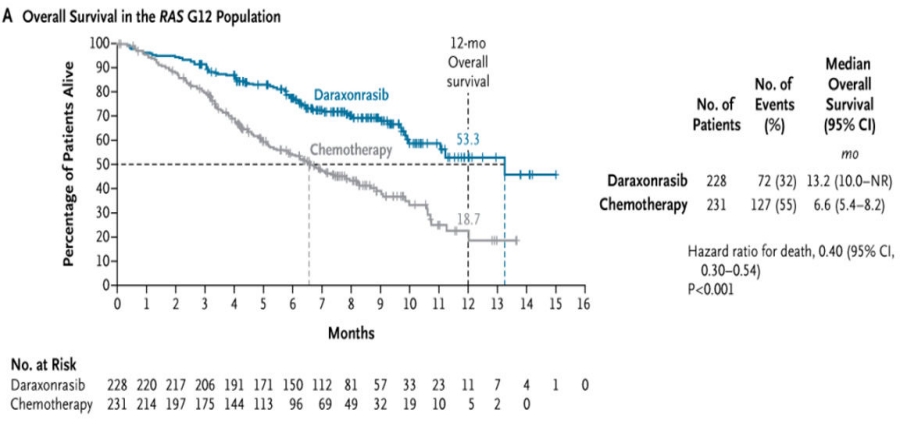
Figure: Difference in survival between the daraxonrasib and standard chemotherapy arms of the RASolute 302 trial on cancer patients with RAS G12-mutations. Source: New England Journal of Medicine, 2026 [3]
In terms of safety, adverse events were common but largely manageable, with typical side effects including rash, diarrhoea, fatigue and mucositis, an inflammation of membranes lining the digestive tract. While unpleasant, these are generally considered tolerable in patients with extremely poor life expectancy whose treatment options are limited. The therapy targets RAS mutations, which are present in over 90% of pancreatic cancers, and represents a significant scientific breakthrough given that RAS has long been considered “undruggable”.
Most targeted therapies apply to small subgroups of cancers. For example, developments in ALK-positive lung cancers are exciting, but only 5% of lung cancer patients have the relevant mutation, limiting the overall impact we can expect on survival. However, pancreatic cancer is overwhelmingly driven by the RAS pathway. 92% of patients with the most common type of pancreatic cancer have RAS mutations. This means, depending on costs and regulatory approvals, potentially most pancreatic cancer patients could one day benefit from this therapy, or others like it. [4]
In fact, the FDA approved usage of the drug in the United States in August 2026, following an expedited review. They cited it as a ‘critical new option for patients facing an extraordinarily difficult and historically hard-to-treat cancer’. The decision came around six months earlier than originally expected, turning what was a promising clinical development into a treatment that can now be prescribed in the world’s largest healthcare market. The European Commission (EC) recently granted approval for the drug to be marketed across the European Union (EU) member states and those of the European Economic Area (EEA).[5] Approvals in other markets are likely to follow soon.
Even more excitingly, RAS drives significant proportions of other cancers, including those in common sites like lung and colorectal disease. In fact, RAS mutations are present in 22% of all cancers, so this could herald the beginning of a broader RAS-driven revolution in targeted cancer therapies. It is unclear whether targeting RAS will always help survival (its role in driving lung cancers is in doubt, for example) but the excitement at the ASCO conference arose in part from the hope that similar approaches could materially improve outcomes across a wide variety of cancer types. [6]
What does this mean for insurers?
From an insurance perspective, there are several implications. First, the therapy is likely to contribute to a gradual reduction in mortality for advanced pancreatic cancer, extending survival modestly beyond historically short timeframes. A minority of patients may see more significant survival benefits. While this development is far from a cure, adding over 6 months’ survival to the lifespan of a typical patient who has already progressed on first line chemotherapy is significant. Claims assessors may find late-stage pancreatic cancer is less often automatically a valid terminal illness claim.
Second, it reinforces a broader shift towards targeted cancer therapies (TCTs), which are often high-cost and may be used over extended periods. As more cancers become treatable in this way and patients survive longer, insurers may face both a larger pool of patients eligible for these therapies and longer periods of treatment. This is particularly relevant to products in some Asian markets that provide benefits specifically for advanced cancer treatments.
More broadly, daraxonrasib is a good example of why emerging medical developments warrant continued close monitoring. What was a promising clinical result only months ago is now becoming an available treatment. Keeping ahead of developments like these allows insurers to anticipate emerging changes in mortality, treatment and claims rather than responding only once their effects become established.
References
[1] Daraxonrasib Doubles Survival in Pancreatic Cancer at ASCO 2026: A Game-Changer
[3] New England Journal of Medicine [@NEJM]. 2026. Original Article: Daraxonrasib or Chemotherapy in Previously Treated Metastatic Pancreatic Cancer (phase 3 RASolute 302 trial). [X]. 1 June. [Last accessed 10 November 2026]. Available from: https://x.com/NEJM/status/2061417607522034139?s=20

Jennifer Chambers
Senior Analyst
























.png)
.png)



.png)